Share Hugh Wells's obituary with others.
Invite friends and family to read the obituary and add memories.
Stay updated
We'll notify you when service details or new memories are added.
You're now following this obituary
We'll email you when there are updates.
Select your format and elements to print

IN LOVING MEMORY OF Hugh Wells
Hugh
Wells
Jul 29, 1928 — Aug 19, 2026
Hugh Wells' Obituary
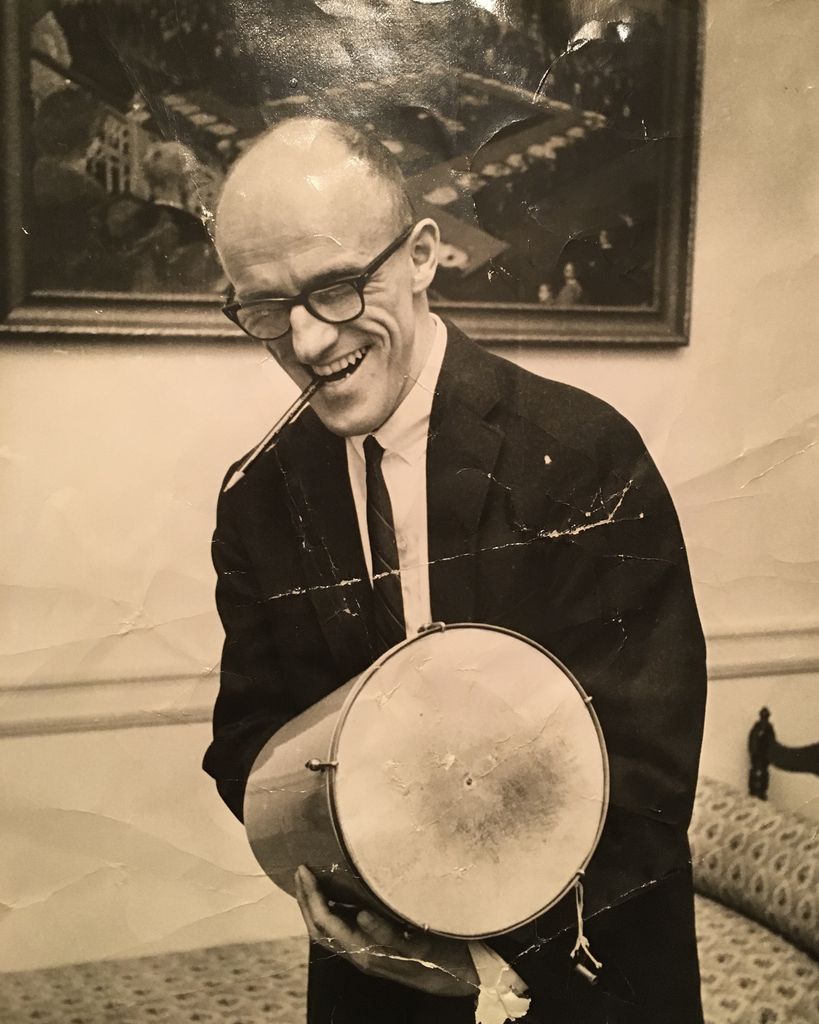
Hugh Wells died of natural causes at age 98 on Aug. 19, 2026, in Salt Lake City. When my brother and I were kids, Hugh could make a Donald Duck voice or pull a quarter from our ears. He could put two fingers in his mouth and whistle deafeningly—his call for us to come home—or bite his lower lip and chirp. He could flip multiple times off a diving board, throw a tight spiral, and, unlike the other dads on the block, sprint. He ran marathons and nearly broke three hours in his 50s, and he still played pickup basketball and hockey with me when I was in high school. He almost never missed my hockey and soccer games, and if he showed up late, he chirped to let me know he was there.
He was at home in water: a member of an Ohio high school state champion relay team and co-captain of the Amherst College swim team in 1951. In 1949-50, which was supposed to be his senior year, he took time off from school and worked as a professional diver at Miami Beach. For Amherst to readmit him, he had to write an essay explaining why his off-year activities were Amherst-worthy. The work he submitted was wholly sarcastic, but Amherst readmitted him nonetheless. He later learned that the essay had circulated among faculty who were amused by it.
Raised by teetotalers in Shaker Heights, Ohio, he didn’t drink at Amherst but made up for it later. He liked swilling beer in rough Detroit bars and was the only dad I knew who had a street name: Curly. For a time, his favorite Cass Corridor bar, Jumbo’s, had another regular who was black and bald, so Hugh (also bald) became White Curly.
Somehow, he was terribly shy and not shy at all. He flirted unabashedly with female servers, even after the world began discouraging it. He said he could get away with it because he was old, short, and bald and wore “Coke-bottle glasses.” Though he didn’t say it, he was also kind and funny. The servers rarely seemed to mind, not even after old age claimed both his timing and discretion.
After graduating from Harvard Business School (which he hated), he wrote a textile company’s financial report in verse … and got fired. He became a reporter and eventually earned a fellowship to Columbia Journalism School, where he studied southeast Asia. He loved being a reporter and the police beat in particular. He had a keen sense of racial and social justice and a strong moral compass. He also had courage. In Cleveland, he rescued numerous people from a bus that had been swept away in a flash flood—a response for which he received a Carnegie Medal nomination. After the rescue, the Cleveland Plain Dealer, his employer at the time, ran a picture of him dripping wet and wrapped in a sheet, along with a caption that noted his resemblance to Mahatma Ghandi.
His life had a “Forrest Gump” quality. He took a class with Robert Frost at Amherst; spent a night carousing with Edwin R. Murrow (after picking him up with the airport); covered the first March on Washington; remembered Carl Bernstein from when Bernstein was a copy boy at the Washington Star; and encountered John Delorean when Delorean was an executive at GM (where Hugh worked for several decades as a speech writer). In a fit of rage, he pushed a desk over on Roger Smith, the GM CEO. Hugh, like Smith, was only about 5-7, and an eyewitness to the desk-toppling compared the pair to “two bantam roosters.” A fine editor, he wrote tightly and honestly. His magazine at GM, The Changing Challenge, won awards in academic circles in the late ‘70s and early ‘80s. A Francophile, he sometimes wore a beret to the GM Building, a look that was never in vogue there.
He had two sons, Hugh Campbell and Alex, and was married once officially, to Sally Ann Phelps, and once unofficially, to Shirley Ramos. He could never keep Shirley’s and Sally’s names straight, but Shirley (the person) stuck with him nonetheless, until she passed from covid.
After retiring from General Motors in 1983, he volunteered in the emergency room of Henry Ford Hospital in downtown Detroit. He worked there for more than two decades, making beds and comforting patients.
The day after he turned 90, he jumped from a boat into a Michigan lake and was shocked to find he could barely swim. I was proud of him for taking the plunge. He is preceded in death by his brother Kenneth, sister-in-law Virginia, sister Jean, partner Shirley Ramos, and son Hugh Campbell Wells. He is survived by his ex-wife Sally Ann Wells, son Alex, numerous nieces and nephews, and countless friends, including much of the staff at Legacy Village.
Hugh Wells' Guestbook
Visits: 0
This site is protected by reCAPTCHA and the
Google Privacy Policy and Terms of Service apply.
Service map data © OpenStreetMap contributors